
How to clean an oven: choose the method your interior allows
A practical oven-cleaning routine for enamel interiors, special coatings and built-in cleaning cycles, with clear manufacturer restrictions.
By Cleaning Notes
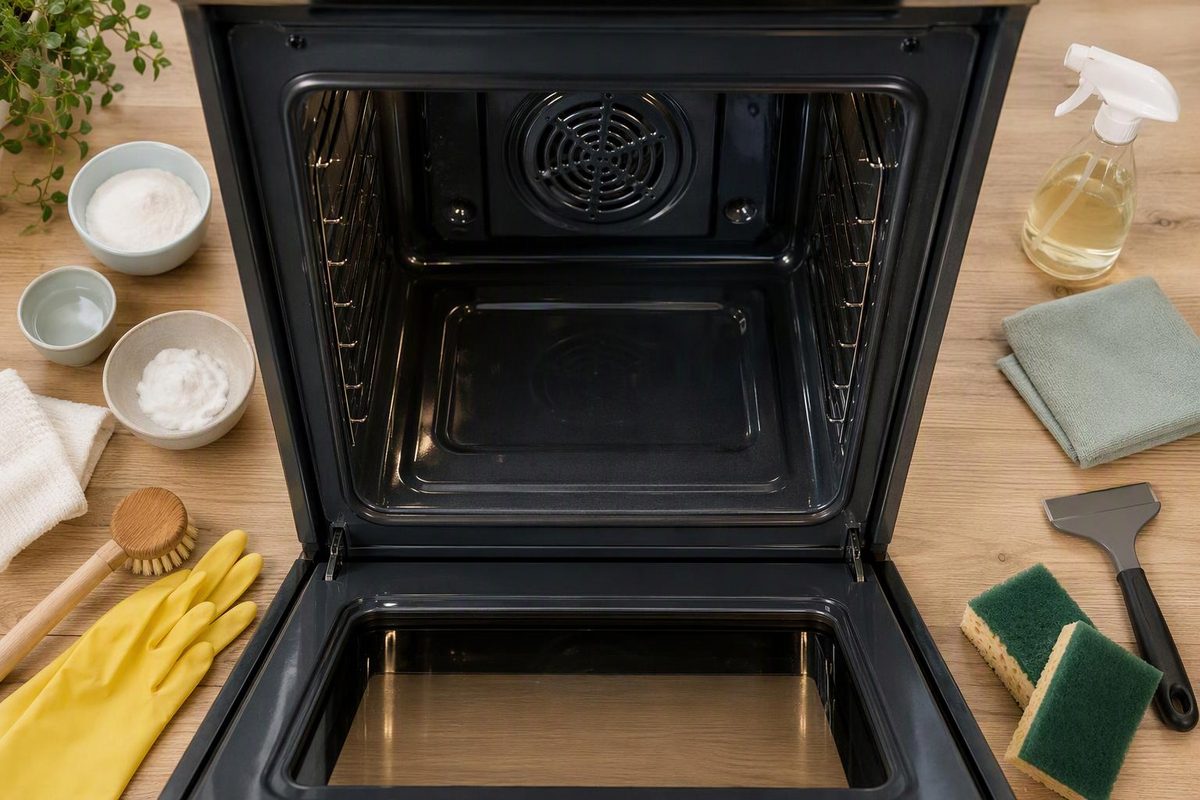
For routine food spills, start with a switched-off, completely cool oven, remove loose crumbs, and wipe surfaces approved for hand cleaning with mild soapy water and a soft cloth. For baked-on residue, the next step depends on your oven’s interior and manual—not simply on how strong a cleaner you can buy. GE’s cleaning guidance supports soap, water and non-scratch tools for manual cleaning.
First, identify what you can clean
Find the cleaning section of the manual for your exact model. Check the cavity walls and floor, door glass, seal and racks separately: they may have different restrictions. For example, Bosch’s HBF154BS0 has rough, self-cleaning coated walls that must not be treated like its smooth surfaces. Bosch’s model manual explains those differences.
Check both the surface and any built-in cleaning function; one oven can have more than one cleaning route.
| What your manual identifies | Cleaning route | Main restriction |
|---|---|---|
| Standard/manual-clean enamel interior | Mild soap and water first; an oven cleaner only if permitted | A product must be suitable for that oven and used as its label directs |
| High-heat self-clean, sometimes called pyrolytic cleaning | Approved hand cleaning for small spills; the built-in cycle for heavier soil | Do not assume commercial oven cleaner is allowed |
| Steam-clean or water-assisted cleaning | The model’s specified water-assisted cycle, followed by wiping | Water quantity, additives and rack instructions are model-specific |
| Special self-cleaning coated surfaces, such as Bosch EcoClean | The coating-care procedure in the manual | Do not apply oven cleaner or abrasive cleaning aids to a coating that prohibits them |
GE’s overview distinguishes manual, self-clean and steam-clean ovens; Bosch’s EcoClean instructions prohibit oven cleaners and abrasive cleaning aids on its coated surfaces.
If you cannot identify the interior, do not escalate to a chemical cleaner or improvised heating method. Locate the manual or ask the manufacturer first. Colour and texture alone are not permission to scrub.
The routine hand-cleaning method
Gather mild dishwashing liquid, warm water, soft cloths and a non-scratch sponge. Use these only on surfaces the manual permits you to wash.
- Switch off and let everything cool. Remove cookware and removable racks. Do not pour water into a hot cavity: Bosch warns that this can create hot steam and damage surfaces. Safety instructions
- Collect loose food and grease. Lift out crumbs with a cloth and wipe up heavy spills before working on stuck-on residue. Do not dismantle heating elements or other components to reach underneath them.
- Soften, then wipe. On washable smooth surfaces, use a cloth dampened with mild soapy water. Work on one patch at a time, repeating gentle wiping rather than switching immediately to an abrasive pad. GE warns that abrasive scrubbers can scratch the interior. Manual-cleaning advice
- Clean accessible door glass gently. GE suggests holding a soapy cloth against the glass for about 10 minutes to loosen grime. Wipe it clean afterward. Do not use a razor, steel wool or harsh abrasive cleaner: Bosch warns that scratched door glass may develop cracks. GE’s door tip · Bosch’s glass warning
- Treat racks separately. Ordinary racks can be washed with warm soapy water and a soft cloth; soaking helps loosen heavier soil. Sliding racks need their own instructions—GE cautions against getting water or cleaner into ball-bearing mechanisms. Bosch rack care · GE rack care
- Remove residue and dry. Wipe washable surfaces with clean water to remove soap, then dry with a soft cloth. Remove any remaining cleaner as its label and the manual require before cooking again. Bosch cleaning instructions · GE cleaner guidance
Leave the door seal out of ordinary scrubbing. Some manuals prohibit cleaning it entirely; others allow gentle washing but prohibit rubbing or removal. Follow yours. GE’s manual for EER2000/EER3000 and listed JBP models prohibits gasket cleaning, while the Bosch HBF154BS0 manual allows soapy water but says not to remove or scrub the seal.
If residue remains, choose one approved next step
Special coated surfaces: follow the coating-care procedure
Do not try to scrub a special coating clean using the smooth-enamel method. For the Bosch HBF154BS0’s EcoClean surfaces, the manual calls for the EcoClean function when dark spots appear. Preparation includes removing cookware, accessories and shelf supports, and cleaning coarse dirt from the smooth floor, inner door and light cover. Follow the complete model procedure, then let the oven cool before wiping. If oven cleaner accidentally touches this coating, Bosch says to dab it off immediately with water and a sponge cloth—not rub. These instructions are specific to that model, not a recipe for every coated liner. Bosch EcoClean care
Steam-clean: for light spills
Use the built-in procedure, not a generic “cup of water” recipe. GE describes steam cleaning as a lower-temperature method for minor spills that still requires wiping afterward. Water instructions differ: GE’s overview specifies plain water for its described cycle, while Bosch’s HBF154BS0 cleaning aid specifies water with a drop of detergent. Neither recipe should be transferred to another model. GE steam-clean guidance · Bosch cleaning-aid instructions
High-heat self-clean: for heavier soil
Remove loose debris and heavy grease first, then follow the manual’s preparation and cycle instructions. Remove racks unless the manual explicitly allows those particular racks to remain: Bosch’s support guidance requires removal, while GE allows some self-clean racks. Ventilate as directed, keep children away from hot surfaces, and wait for cooling and unlocking before wiping out ash—never force the door. If you keep birds, note GE’s warning that self-clean fumes can affect them and its instruction to move them to another well-ventilated room. Bosch rack restrictions · GE self-clean guidance · GE cycle safety instructions
Oven cleaner: only with permission from both instructions
Use a commercial oven cleaner only when the appliance manual permits it and the product label covers that use. Follow the label’s temperature, contact time, protective equipment, ventilation and removal instructions. GE prohibits commercial oven cleaner in its described high-heat self-clean ovens, but permits suitable products for standard-clean ovens—so “oven cleaner” is not universal approval. GE’s restrictions
Baking soda paste is not a universal method either: use it only where the manual permits it. A homemade recipe does not override restrictions on abrasive cleaning aids. Use one approved method at a time; never add bleach to another cleaner. See why bleach should never be mixed with household cleaners.
When to stop
Stop cleaning and seek the manufacturer’s advice if you find cracked glass, a damaged or displaced seal, or an error that persists. Do not operate a damaged appliance. These are inspection or service problems, not reasons to scrub harder. Bosch safety and troubleshooting instructions · GE seal guidance
For ongoing upkeep, wipe spills once the oven is cool rather than repeatedly baking them on. That small job can reduce the need for a major clean. GE routine-care guidance